Friday, 5 May 2017

1780-luku: Osa 2 -- 1780's: Part 2


Säätyläisnaisen alusvaatteet

Lisää suorakaiteita ja kolmioita

A Gentlewoman and Her Undergarments

More Squares and Rectangles

 
1780-luvun aluspaita, kureliivi ja alushame. Korsetin kaava löytyy kirjasta Corsets and Crinolines. A 1780's shift worn under a petticoat and stays. The pattern for the stays comes from Nora Waughs Corsets and Crinolines. Kuva /Photo: neulansilmanlapi.blogspot.fi

Historical Sew Fortnightly

Jokin aika sitten päätin ottaa osaa HSF:n haasteeseen, sillä ajattelin sen rytmittävän mukavasti myös tätä projektia. Huhtikuun haasteena oli valmistaa jotakin suorakaiteista, kolmioista ja ympyröistä. Ensin ajattelin tekeväni jotakin monimutkaisempaa, mutta lopulta se kuuluisa elämä ja todelliset tarpeet tulivat tielle ja päätin tehdä sen iänikuisen tylsän aluspaidan - koska tarvitsen sellaisen. Ympyräksi olin kaavaillut uutta monimutkaisempaa myssyä, mutta valitettavasti en ehtinyt.

A little while ago I decided to take part in the HSF challenge, since I thought it would be a nice way to give a little and regular boosts to the project at hand. The challenge for April was to create something from rectangles, squares and circles. First, I was planning to make something more elaborate, but in the end, the infamous life and circumstances got in the way. Instead, I decided to do something I really needed: a plain and boring shift. I was planning to use the circle for a more elaborate new cap, but unfortunately I run  out of time.
 

Aluspaita

The Shift
Aluspaidan kaava on se sama nk. englantilaisittain leikatun paidan kaava, jota käytin palvelusneidon paidassa. Ero löytyy kankaan laadusta.

The shift is cut in the sc. English manner like the shift I made for the servant. The only difference is in the fabric. 

1780-luvun aluspaita. A 1780's shift. Kuva / Photo: neulansimanlapi.blogspot.fi
 
 
1700-luvun aluspaidan pääntien rullapäärme. The neckline of the 18th century shift is finsihed witha a tint rolled seam. Kuva / Photo: neulansilmanlapi.blogspot.fi

Kuva / Photo: neulansimanlapi.blogspot.fi

Sauma on ommeltu taka- ja luotospistolla valkaistulla pellavalangalla. The seams are back-stitched and felled with bleached linen thread. Kuva / Photo: neulansimanlapi.blogspot.fi


The Challenge: Circles, Squares &  Rectangles
Material: Light weight white linen
Pattern: I drafted it myself. My goal was to achieve a very thight fight across the chest so I could avoid wrinkling when wearing stays.

Year: Late 18th century

Notions: I had to readjust the hemline before the photoshoot. I also failed to add the circles to the project.
How historically accurate is it? It's entirely hand-sewn using period materials and techniques.

Hours to complete: I forgot to time it. I was making it in-between other projects. Usually it takes me about 6 - 8 hours to complete a shift like this, but this time I got distracted and did it over a period of three weeks.
First worn: For fitting a new pair of stays and the photoshoot.
Total cost: 16 euros


Tuesday, 14 March 2017

1780-luku: Uusi projekti, osa 1 - 1780's: A new project, part 1

Mitä 1780-luvun suomalaisella palvelustytöllä oli yllään? 

1. osa: alusvaatteet

What did a 1780's Finnish maid wear?

Part 1: undergarments


 1700-luvulla aluspaidan alaosa ommeltiin joskus säästäväisyyssyistä karkeampilaatuisesta pellavakankaasta kuin sen yläosa. During the 18th century, the lower part of the chemise or smock was sometimes made of a coarser fabric for economical reasons.

Inspiraatio

The inspiration 

Viime syksystä asti olen pyöritellyt toden teolla päässäni uutta 1700-luvun lopulle sijoittuvaa ompeluprojektia. Projekti perustuu vuonna 1995 julkaistuun paperinukkeen, jonka sisältämät puvut pohjautuvat pääosin Turun museokeskuksen (julkaisuaikana Turun maakuntamuseo) kokoelmiin. Paketissa on kaksi hahmoa: kustavilaisen ajan säätyläisrouva ja palvelustyttö. Ensin mainitulla on useampikin asukokonaisuus - kuten arvata saattaa. Palvelustytöllä vain yksi. Jos onni suo, niin ehkäpä pystyn tulevaisuudessa esittelemään kyseistä paperinukkea hieman tarkemmin.

Ever since last fall I've been planning a new late 18th century  sewing project. This  project is inspired by a set of paperdolls published in 1995. What is great about this is, that most of the dresses in this thing are based on actual garments that are kept in the collections of Turku Museum Centre. The set has two charachters: a late 18th century gentlewoman and her maid. The first mentioned has several outfits to choose from - as one might imagine. The servant gril has only one set of clothing. I hope I can show you some details of this lovely paperdoll set in the future.


1700-luvun aluspaita ulottui usein vain puolisääreen. An 18th century chemice usually reached around the mid shin.


1700-luvun lopun aluspaita

Late 18th century smock or chemise

1700-luvun aluspaidat valmistettiin aiempien vuosisatojen tapaa usein pellavasta. Puuvillasta valmistettuja aluspaitoja alkoi ilmaantua vasta vuosisadan lopulla. Paidat leikattiin yhä keskiajalta tuttuun tapaan suorakaiteita, nelikulmioita ja kolmiokiiloja yhdistelemällä. Joitakin vivahde-eroja kuitenkin oli: esimerkiksi hihat lyhenivät ensin 1600-luvulla ranteesta kyynärpäähän. 1700-luvun lopulla hihat kapenivat ja lyhenivät vielä entisestään.

Paidan omistajan sosioekonominen asema vaikutti käytettävissä olevan kankaan laatuun: vaikka säätyläisrouvillakin oli varaa teettää paitoja arvokkaasta hollanninpalttinasta, saattoivat hekin käyttää kotikutoisesta kankaasta valmistettuja paitoja arkipukiminaan. 


Räätälimestari Sieur Garsaltin kirjasta L'Art de la lingère, vuodelta 1771. Teos esittelee ranskalaisen (B) ja kaksi englantilaista leikkaustapaa (A ja C). Master tailor Sieur Garsalts book L'Art de la lingère from 1771. The books shows a French (B) and two English (A and C) ways to cut the smock. http://gallica.bnf.fr/ark:/12148/btv1b7200315v/f72.item.zoom


Linen was probably the most common material for 18th century smocks as it had been in the previous centuries. Cotton smocks appear first during the end of the century. The smocks were cut and pieced from squares and triangular gores, as they had been ever since the middle ages. The changes were quite small: for example, during the 17th century the sleeves became shorter, rising from the wrists to the elbows. During the end of the 18th century the sleeves became narrower and even shorter.

The socioeconomical status of the wearer could be seen on the quality of the fabrics: although a gentile lady could afford to have her smocks made out of the costly imported Dutch linens, even their everyday smock might have been made out of home spun and woven linens.  


Palvelustytön arkinen aluspaita

Serving girls everyday smock

Palvelijattaren aluspaita on leikattu englantilaiseen tapaan, joka vaikuttaa suositulta vuosisadan lopun Suomessa. Sen yläosa on keskipaksua valkoista pellavapalttinaa ja alaosa karkeampaa valkaisematonta pellavaa. Kaikki on ommeltu käsin pellavalangalla.

The maid's smock is cut in the English way, which appears to be the preferred way in late 18th century Finland. The top is made of mid weight white plainwoven linen and the lower part is made of a coarser unbleached linen. Everything is hand-sewn with linen thread.

Aluspaidan englantilainen leikkaus. The English cut of the smock.


Helman oikea puoli on leikattu viistoon... The right side of the hem is cut on bias...


... ja vasenta puolta täydentää kolmion muotoinen kiila - aivan kuten Garsaultin kirjassa! ... and the left side is completed with a triangular gore - just like in Garsault's book!


Kainalokiila ja ei niin siistit katesaumat. Ensi kerralla siistimmin.... The armpit gore and the not so neat felled seams. I'll try to do better next time...


Pellava-alushame

The linen Petticoat 


Alushameen kangas jäljittelee pehmeäksi käytössä kulunutta valkaisematonta rohdinpellavaa.

The linen fabric of the petticoat imitates the linens woven from flax tow and softened by regular use and washing.


1700-luvun palvelustytön alushame. 18th century servan girls petticoat.


Hame rakentuu yhdesta etu- ja takakappaleesta. Kapeammilla aikalaiskankailla eteen ja taakse olisi tullut sauma. The petticoat is made on a front and a back piece. With the narrower contemorary fabrics there would have been two additional seams on the centre front and back.


Alushame puetaan seuraavasti: ensin takaosan vyötärönauha sidotaan eteen... The petticoat is dressed like this: first the ribbons of the back piece are tied at the waist...


... lopuksi etuosa kiinnitetään samaan tapaan nauhoilla solmimalla. ...lastly, the front side is attached with the ribbon in a similar fashion.


Ja voilà: aluskerrokset on puettu! And voilà: the undergarments are on!


 PS. Pääasiat ansaitsevat aivan oman juttunsa. Lisää on tulossa!

 PS. The headwear deserves a posting of it's own. Stay tuned for more!


Tuesday, 7 March 2017

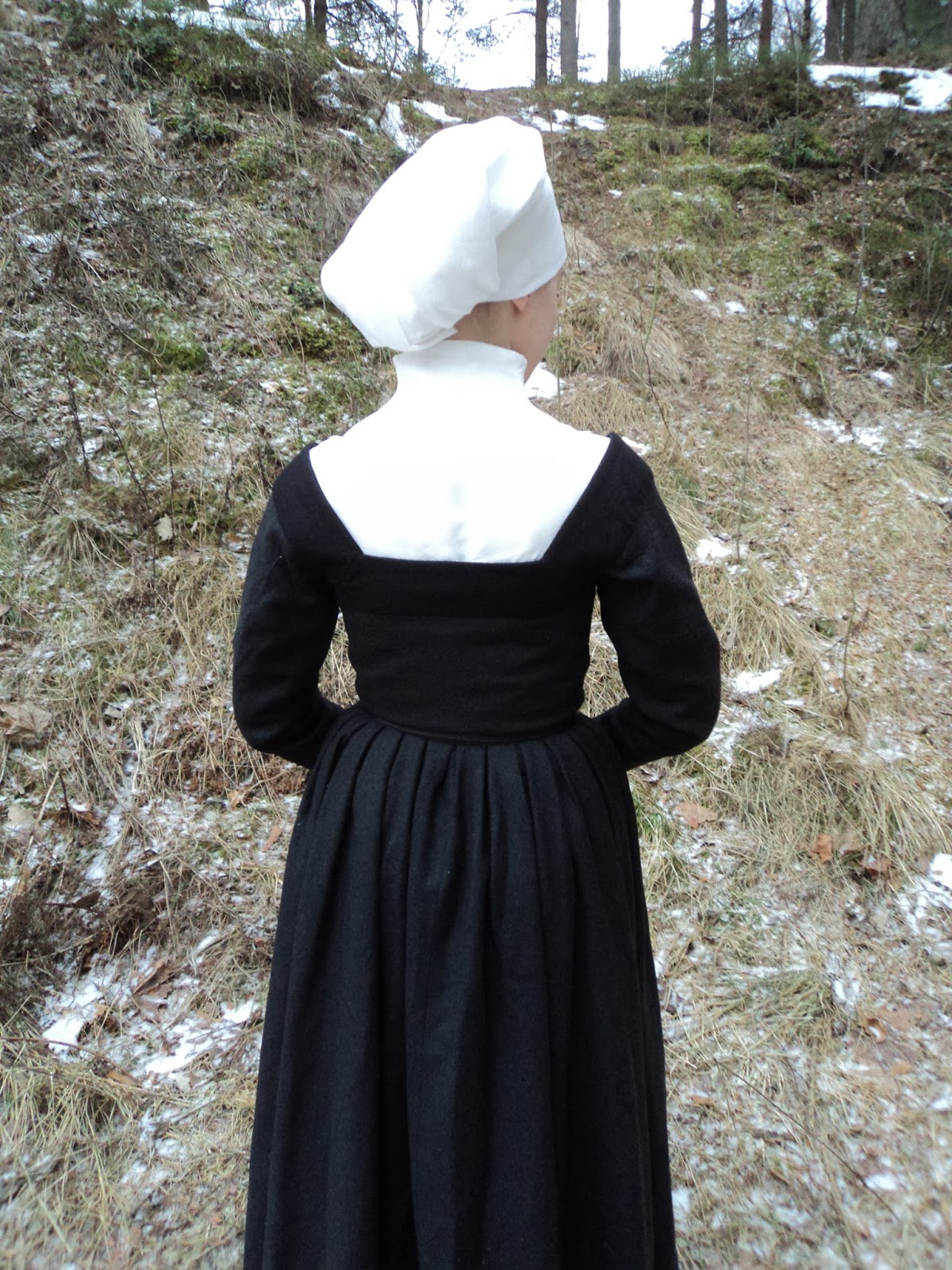
1520-luvun harmaa puku ja kaksi ritamusta

A 1520's grey dress and two partlets


Rakastavaisten naisen pukukokonaisuus ei suinkaan ollut aivan ensimmäinen saksalaistyylinen renessanssipukuni. Sitä ennen olin tehnyt eräänlaisena harjoitusversiona alempaa löytyvään maalaukseen perustuvan hameen. Syystä tai toisesta en tullut dokumentoineeksi tätä pukua laisinkaan. Pari päivää sitten päätin vihdoin kuvauttaa sen. Ikävä kyllä, ne kuvat eivät onnistuneet sääolosuhteiden vuoksi kovinkaan hyvin, joten yritimme tänään uudelleen paremmalla onnella.

The Lovers dress was by no means my first dress in the style of the German renaissance. Before it, I had made a kind of a trial dress based on the painting further below. For one reason or another, I never got around to documenting this one. A few days ago I finally decided to photograph it. Unfortunately those pictures did not turn out too well, so we thought to try again today and with better luck.


Harmaa puku on ohutta villatoimikasta ja se on reunustettu mustalla villapalttinalla. Ja kyllä, kaikki on ommeltu käsin. Ehkä sen huomaa, mutta en oikein pidä ompelukoneista....

The grey dress is made of grey wool twill and it's edged with black plain woven wool fabric. And yes, everything is sewn by hand. I guess my aversion to sewing machine is showing...


Puvun liivimäinen yläosa on leikattu kahdesta etukappaleesta ja yhdestä takakappaleesta.

The vest-like bodice consists of two front pieces and of one back piece. 


Liivi sulkeutuu edestä hakasin. Puvun yläosa on vuorattu kahdella erilaatuisella pellavalla.

The bodice closes with hooks and eyes. The upper part of the dress is lined with two different types of linen.


Hame on leikattu 1500-luvun lopun itävaltalaisten räätälinkirjojen ohjeiden mukaan yhteensä neljästä osasta: kahdesta etu- ja takakappaleesta. Helman leveys on n. 500 cm. Hameen vuori on mustaa pellavaa / pellavasekoitetta.

The skirt is cut in four pieces after the examples is late 16th century Austrian tailor's books, with two front and two back pieces. The hem circumference is c. 500 cm. It's lined with black linen / linen blend.


Uusien projektien yhteydessä on myös mukava kokeilla erilaisia tekniikoita. Tämän projektin kohdalla kokeilin nk. topattua helmaa. Harmaan hameen helma on käännetty vinoon langansuuntaan leikatulla mustalla villakankaalla, jonka sisältä löytyy ohut pellavakaistale. Tekniikkaan voi tutustua täällä.

I like to experiment with new construction techniques every time I make something new. The new thing with this one, is the so called padded hem. The hem is turned wit the bias cut black wool and padded with strip of linen. You can read more about the padded hem here.


Puvun innoittajana toimi Hans Brosamerille (k. 1552) attribuoitu maalaus. Se esittää myöhempien tietojen mukaan 38-vuotiasta Katharina Meriania. Naisen asukokonaisuuden ja asusteiden tyyli viittaa 1520-luvun Nurembergiin. Lisää tietoja maalauksesta löytyy täältä. 

The grey dress is inspired by a painting attributed to Hans Brosamer (d. 1552). A later inscription tells that it is a portrait of a Katharina Merina, aged 38. Her dress and accessories point to 1520's Nuremberg. More information on the painting can be found here.


The Met


Rintamuksen brokadikangas on halpaa keinokuitua ja vuorattu viininpunaisella paksulla villatoimikkaalla. Suoraan sanottuna sen kuvio ei ole aivan oikeaoppinen: se muistuttaa viktoriaanisia sisustuskankaita, jotka tosin saivat innoituksensa renessanssista. Koska kyseessä oli harjoituskappale, en ajatellut laittavani rahaa alkuperäisiä kankaita jäljittelviin damasteihin.

The partlet is made of a cheap syntethic brocade and lined with thick wine red wool twill. Frankly, the pattern is not completely authentic: it reminds me of the victorian fabrics used in soft furnishings that got their inspirations from the renaissance. Yet, since this was a trial piece, I was not prepared to splurge on reproduction damasks.


Rintamuksen innoitajana toiminut muotokuva löytyy esimerkiksi täältä.

The inspiration for the partlet came from this portrait. 


Alla oleva valkoinen rintamus on ommeltu kaksinkertaisesta ohuesta pellavasta ja suljettu neuloilla.

The white partlet underneath is sewn from two layers of thin linen and closed with pins.


Mistä huomaa, että hunnun alla oleva wulsthaube ei ole aivan valmis....?

Can you tell that the wulsthaube underneath the veil is not finished...? 


Kaiken kaikkiaan puku ei kuitenkaan ole hassumpi. Ehkäpä sille löytyy vielä käyttöä ;-)

All in all it's quite nice for a first try. Perhaps I'll find some use for it ;-)


Sunday, 12 February 2017


Turun linnan rakastavaiset - Kuvasta todeksi

The Lover's of Turku Castle - From Image to Reality 


Photo: Karo Suominen


Turun linnan Portinvartijan kamarin läntiseltä seinältä löytyy kuva saksalaiseen tapaan pukeutuneesta parista. Maalaus on askarruttanut mieltäni aina siitä asti, kun aloitin työni linnan museo-oppaana vuonna 2010. Kyseinen maalaus tunnetaan varsin yleisesti nimellä "rakastavaiset". Se on yksi kolmesta huoneesta löytyvästä ihmishahmoja esittävistä kuva-aiheista. Neljäs maalausryhmä löytyy huoneen itäiseltä puolelta, jossa on samankaltaisia köynnöskuvioita kuin rakastavaisten ja pohjoiselta seinältä löytyvän hahmon ympäriltä.  Maalaukset on ajoitettu 1530-luvun taitteeseen.

There is an image of a couple dressed in the German style on the western wall in the room known as The Porter's Lodge in Turku Castle. The painting has intrigued my imagination ever since I began my work there as a museum guide back in 2010. They are known as "The Lovers". They're one of three images remaining in the room depicting people. The fourth image group depicts similar vegetation that can be seen surrounding The Lovers and another figure on the norther wall. The paintings are dated to c. 1530.


Kuva: Museovirasto


Olin jo pitkään haaveillut maalauksessa esiintyvien pukujen valmistamisesta. Vuoden 2016 taitteessa päätin vihdoinkin ryhtyä tuumasta toimeen. Tämän projektin johdosta muut ompelukset saivat luvan odottaa. Puvut on kuvattu tammikuussa Turun linnan renessanssikerroksessa.  Entä missä ne voi nähdä livenä? No 17.2.2017 aukeavassa näyttelyssä Valtapeliä - Reformaatio Suomessa Turun linnassa tietenkin!

For a long time, I had dreamed about making the garments depicted on the image. At last, in the beginning of the year 2016 I finally decided to start the project. This was indeed the project of the 2016, so other sewing projects were put aside. The photo shoot took place in January on the renaissance floor of Turku Castle. And where can you see these garments? In the exhibition Game of Power - Reformation in Finland which open in Turku Caslte on the 17th of February 2017!
 

Photo: Karo Suominen


Naisen puvussa on neljä kerrosta: alimpana ohuesta valkeasta pellavasta valmistettu aluspaita, jonka päälle on puettu ruskeasta villasekoitteesta valmistettu hihaton liivihame. Koska maalauksessa naisen rintamuksen avonaisen kauluksen alta ei näy aikakaudelle muutoin tyypillistä korkeakauluksista aluspaitaa, päädyin matalampaan pääntiehen. Esikuva löytyy täältä.

The woman's attire has four layers: a fine white linen smock and a brown wool-blend kirtle/petticoat without sleeves. Since the open partlet on the open collar of the partler in the painting does not reveal a typical high necked smock, I decided to make one with a lower neckline. The inspiration for this neckline can be found here.


Photo: Karo Suominen


Päällyshameena on samankaltainen hihallinen liivihame, jonka pääntie, miehusta ja kalvosimet on koristeltu vihreällä damastilla. Hameen helmaa koristaa harmaasta villasta tehtyy päärme. Päällyshame on leikattu n. 5 cm lyhyemmäksi kuin alushame. Jälkeenpäin ajatellen päällyspuku olisi saanut olla vieläkin lyhyempi, jotta aluspuvun helma tulisi paremmin esiin.

The overdress or gown is similarly cut sleeved kirtle, with green damask decorations on the neckline, bodice front and the cuffs. The red dress has a wide guard of grey wool at the bottom of the hem.  On hindsight, the overgown could have been even shorter.


 Photo: Karo Suominen

Maalauksessa naisen asun kuviokangas on maalattu vihreällä ja punaruskealla. En kuitenkaan onnistunut löytämään hinta-laatusuhteeltaan sopivaa kaksiväristä damastia tai leikattua samettia, joten päädyin yksiväriseen vaihtoehtoon. Damasti on ostettu täältä. Se muistuttaa hieman silkkiä, joka löytyy Metin kokoelmista ja eräästä Hans Holbein vanhemman maalamasta muotokuvasta. 

The patterned fabric on the painting was done with green and reddish-browns colours. I was not able to find a suitable and affordable two-toned fabric, so I settled for a monochrome alternative. I got the damast from here. It's similar to a silk in the Met collections and the one depicted in a portrait by Hans Holbein the elder.

Photo: Karo Suominen


Alkuperäisessä maalauksessa vyön ja esiliinan yksityiskohdat ovat epäselvät. Päädyin lopulta nk. hunajakenno-smokattuun esiliinan, sillä tällä tavoin rypytetty esiliina korostaa muodikasta vatsan pyöreyttä entisestään.

The details of the belt and the apron are not very clear on the painting. In the end I decided upon the well documented honeycomb smocking on the apron, because it accentuates the fashionable curve of the belly.


Photo: Karo Suominen


Asun viimeistelee pääntien peittävä rintamus/kaulus, (saks. goller, ruots. krage, engl. partlet). Damastista valmistetussa kauluksessa on villavuori ja se on reunustettu samalla keltaisella villalla. Valinta on kompromissi, jonka kautta olen tavoitellut lähinna visuaalista harmoniaa pukujen esikuvan kanssa. Villainen reunus on ehkä historiallisessa mielessä outo valinta, sillä tällaisten vaatekappaleiden koristeluun käytettiin useimmiten arvokkaampia kankaita, kuten silkkiä ja samettia. Alkuperäisenä ajatuksenani olikin käyttää keltaista samettia, mutta en onnistunut löytämään miehen asussa käytetyn villan kanssa yhteen sopivaa sävyä. 

The outfit is finnished with a partlet (goller in german and krage in swedish). It's made of the green damast and has a white woollen lining for warmth. The edges are decorated with fine yellow wool. The choice was a compromise, through which I was aiming to harmonize the visual effect with the original image. Historically speaking, a woollen decoration on a damask partlet is odd, since different silks and velvets would have been the prefferred choice of the day. My original idea was to use some sort of silk or velvet for this job, but I was unable to locate either in a colour that would match the yellow wool  nicely.


Photo: Karo Suominen


Pussukka on valmistettu säämiskästä. Sen esikuvana toimi pussukkatyyppi, joka löytyy esim. Germanisches Nationalmuseumista

The purse is made of shammy leather by Mikke. It's modelled after the type found for example in Germanisches Nationalmuseum.


Photo: Karo Suominen


Naisen hattu on valmistettu huovutetusta villapalttinasta. Hatun tukirunkona on olkihatun lieri. Sen reuna on lävistetty taltalla. Koristenauha on pujoteltu reikien läpi. Miehen hattu on tehty samalla periaatteella, mutta päällystin sen villan sijaan sametilla ja koristenauha on vihreää taftia.

The hat is made of heavily felted wool tabby. It's supported with the brim of a strawhat. The edge of the fabric is pierced with a chisel and the decorative ribbon is pulled through the openings. The construction of the man's hat is basically the same, but I used velvet to cover it and green taffeta for the brim decoration.


Photo: Karo Suominen


Itselleen on toki aina mukavaa tehdä uusia vaatteita, mutta tässä projektissa ehdoton suosikkini on kuitenkin miehen asu. Se on hävyttömän ihana. Ennen kaikkea, se vaatii aika paljon käyttäjältään. Kaikeksi onneksi minulla olikin sopiva malli mielessä. Ja ei: en kysynyt haluaako Mikke ylipäätään tällaiset vermeet... 

Although it's always nice to make new things that you can wear yourself, my all time favourite is the man's outfit. It's outrageously faboulous. It definately requires quite a lot from the wearer. And no: I did not ask how Mikke felt about wearing such an outfit...


Photo: Karo Suominen


Photo: Karo Suominen


Miehen röijy ja hoset ovat valkoista villaa. Nyörit ovat nahkaa, pointit messinkiä ja sukkanauhat vihreää silkkitaftia. Hattu on punaista samettia. Aluspaidaksi päätyi lopulta korkeakauluksinen "harjoituspaita". Se onkin ainoa osa koko puvustosta, joka on koottu koneella, mutta huoliteltu ja kirottu käsin. Tarkoitukseni oli tehdä toinen paita täysin käsin, mutta joskus elämä tulee väliin ja sotkee alkuperäiset suunnitelmat...

The doublet, or wams, and the hose are made of the same white wool. The  laces are leather, the aiglet are made of brass and the garters are a rectangular piece of silk taffeta.  The hat is made of velvet. The smock is the only garment that was assmbled by machine, but finished and embroidered by hand. Other pieces are entirely hand-sewn. Originally this smock was supposed to be a practice piece and I was supposed to do another one entirely by hand, but alas, life got in the way...


Photo: Karo Suominen

Photo: Karo Suominen


Photo: Karo Suominen


Miehen takkimaisen lievejakun, waffenrockin helma on täyskello ja leikattu neljästä osasta. Jokainen raita on leikattu muotoon ja ommeltu kiinni hamekankaaseen. Kyllä, siihen meni ikuisuudelta tuntuva aika... Hihat on vuorattu vihreällä pellavalla.

The skirt of the coat like arms jacket, waffenrock, is a full circle. It's cut from four 1/4 piece. Each stripe is cut to form and sewn to the skirt fabric. Yes, it felt like it took forever to sew those in place... The sleeves are lined with green linen.


Kengät: Elina Laitinen. Shoes by Elina Laitinen. Photo: Karo Suominen


Jalassa on tietysti aivan mahtavan hienot maalauksen innoittamat kengät. Niiden tekijä on taitava ja lahjakas muinaistekniikan artesaani Elina Laitinen, joka myös kävi sivukaupalla läpi kenkiin liittyviä arkeologisia lähdeteoksia.  

The outfit could not be completed without shoes. These are handmade by the talented artesan of ancient techniques Elina Laitinen. They are inspired by the painting and I know she poured ower archeological source material over these.


Photo: Karo Suominen


Kuvauksissa oli mukana tietysti myös Jani, jonka asun inspiraationa on toiminut portinvartijan kamarin pohjoiselta seinältä löytyvä maalaus. Hän myös yllätti meidät iloisesti pukemalla ja aseistamalla Mikken asiaan kuuluvin varustein.

Jani was of course part of the photo shoot, wearing a landsknecht outfit inspired by the painting on the northern wall of the Porter's Lodge. He had a surprise for us and he equipped Mikke with the appropriate armoury.


Photo: Karo Suominen


Photo: Karo Suominen


Photo: Karo Suominen


Landsknecht romantiikkaa....?

Landsknecht romance....? 
 

 Photo: Karo Suominen