Turun linnan rakastavaiset - Kuvasta todeksi
The Lover's of Turku Castle - From Image to Reality
 |
| Photo: Karo Suominen |
Turun linnan Portinvartijan
kamarin läntiseltä seinältä löytyy kuva saksalaiseen tapaan pukeutuneesta parista. Maalaus on askarruttanut mieltäni aina
siitä asti, kun aloitin työni linnan museo-oppaana vuonna 2010. Kyseinen
maalaus tunnetaan varsin yleisesti nimellä "rakastavaiset". Se on
yksi kolmesta huoneesta löytyvästä ihmishahmoja esittävistä kuva-aiheista.
Neljäs maalausryhmä löytyy huoneen itäiseltä puolelta, jossa on samankaltaisia
köynnöskuvioita kuin rakastavaisten ja pohjoiselta seinältä löytyvän hahmon
ympäriltä. Maalaukset on ajoitettu 1530-luvun taitteeseen.
There
is an image of a couple dressed in the German style on the western wall in the room known as The Porter's Lodge in
Turku Castle. The painting has intrigued my imagination ever since I began my work there
as a museum guide back in 2010. They are known as "The Lovers".
They're one of three images remaining in the room depicting people. The fourth
image group depicts similar vegetation that can be seen surrounding The Lovers
and another figure on the norther wall. The paintings are dated to c. 1530.
Olin jo pitkään haaveillut maalauksessa esiintyvien pukujen valmistamisesta. Vuoden 2016 taitteessa päätin vihdoinkin ryhtyä tuumasta toimeen. Tämän projektin johdosta muut ompelukset saivat luvan odottaa. Puvut on kuvattu tammikuussa Turun linnan renessanssikerroksessa. Entä missä ne voi nähdä livenä? No 17.2.2017 aukeavassa näyttelyssä Valtapeliä - Reformaatio Suomessa Turun linnassa tietenkin!
For a long time, I had dreamed about making the garments depicted on the image. At last, in the beginning of the year 2016 I finally decided to start the project. This was indeed the project of the 2016, so other sewing projects were put aside. The photo shoot took place in January on the renaissance floor of Turku Castle. And where can you see these garments? In the exhibition Game of Power - Reformation in Finland which open in Turku Caslte on the 17th of February 2017!
 |
| Photo: Karo Suominen |
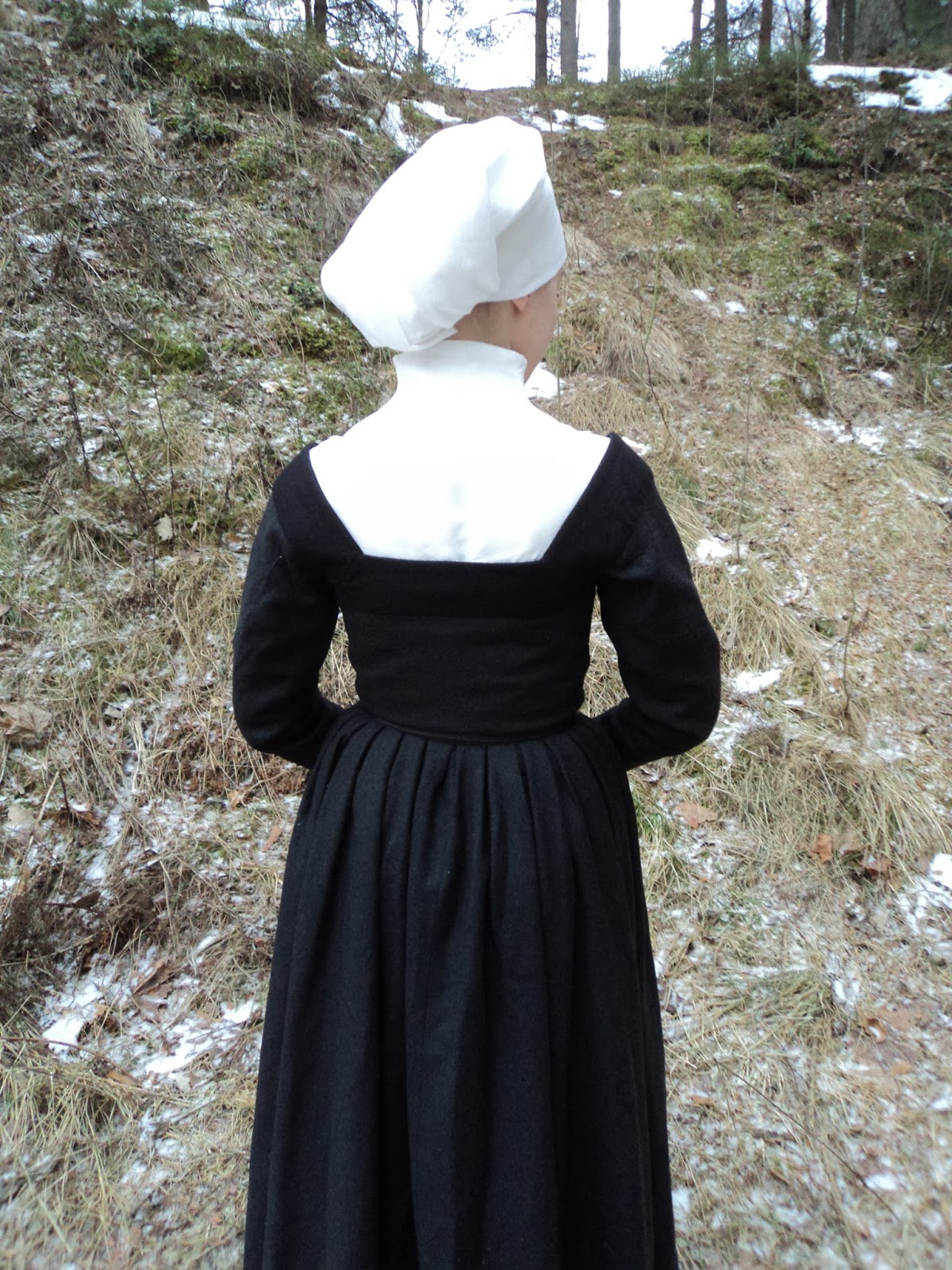
Naisen puvussa on neljä kerrosta: alimpana ohuesta valkeasta pellavasta valmistettu aluspaita, jonka päälle on puettu ruskeasta villasekoitteesta valmistettu hihaton liivihame. Koska maalauksessa naisen rintamuksen avonaisen kauluksen alta ei näy aikakaudelle muutoin tyypillistä korkeakauluksista aluspaitaa, päädyin matalampaan pääntiehen. Esikuva löytyy täältä.
The woman's attire has four layers: a fine white linen smock and a brown wool-blend kirtle/petticoat without sleeves. Since the open partlet on the open collar of the partler in the painting does not reveal a typical high necked smock, I decided to make one with a lower neckline. The inspiration for this neckline can be found here.
 |
| Photo: Karo Suominen |
 |
| Photo: Karo Suominen |
Päällyshameena on samankaltainen hihallinen liivihame, jonka pääntie, miehusta ja kalvosimet on koristeltu vihreällä damastilla. Hameen helmaa koristaa harmaasta villasta tehtyy päärme. Päällyshame on leikattu n. 5 cm lyhyemmäksi kuin alushame. Jälkeenpäin ajatellen päällyspuku olisi saanut olla vieläkin lyhyempi, jotta aluspuvun helma tulisi paremmin esiin.
The overdress or gown is similarly cut sleeved kirtle, with green damask decorations on the neckline, bodice front and the cuffs. The red dress has a wide guard of grey wool at the bottom of the hem. On hindsight, the overgown could have been even shorter.
 |
| Photo: Karo Suominen |
Maalauksessa
naisen asun kuviokangas on maalattu vihreällä ja punaruskealla. En
kuitenkaan onnistunut löytämään hinta-laatusuhteeltaan sopivaa
kaksiväristä damastia tai leikattua samettia, joten päädyin yksiväriseen
vaihtoehtoon. Damasti on ostettu täältä. Se muistuttaa hieman silkkiä, joka löytyy Metin kokoelmista ja eräästä Hans Holbein vanhemman maalamasta muotokuvasta.
The patterned fabric on the painting was done with green and
reddish-browns colours. I was not able to find a suitable and affordable
two-toned fabric, so I settled for a monochrome alternative. I got the
damast from here. It's similar to a silk in the Met collections and the one depicted in a portrait by Hans Holbein the elder.
 |
| Photo: Karo Suominen |
Alkuperäisessä maalauksessa vyön ja esiliinan yksityiskohdat ovat epäselvät. Päädyin lopulta nk. hunajakenno-smokattuun esiliinan, sillä tällä tavoin rypytetty esiliina korostaa muodikasta vatsan pyöreyttä entisestään.
The details of the belt and the apron are not very clear on the painting. In the end I decided upon the well documented honeycomb smocking on the apron, because it accentuates the fashionable curve of the belly.
 |
| Photo: Karo Suominen |
Asun viimeistelee pääntien peittävä rintamus/kaulus, (saks. goller, ruots. krage, engl. partlet). Damastista valmistetussa kauluksessa on villavuori ja se on reunustettu samalla keltaisella villalla. Valinta on kompromissi, jonka kautta olen tavoitellut lähinna visuaalista harmoniaa pukujen esikuvan kanssa. Villainen reunus on ehkä historiallisessa mielessä outo valinta, sillä tällaisten vaatekappaleiden koristeluun käytettiin useimmiten arvokkaampia kankaita, kuten silkkiä ja samettia. Alkuperäisenä ajatuksenani olikin käyttää keltaista samettia, mutta en onnistunut löytämään miehen asussa käytetyn villan kanssa yhteen sopivaa sävyä.
The outfit is finnished with a partlet (goller in german and krage
in swedish). It's made of the green damast and has a white woollen
lining for warmth. The edges are decorated with fine yellow wool. The
choice was a compromise, through which I was aiming to harmonize the
visual effect with the original image. Historically speaking, a woollen
decoration on a damask partlet is odd, since different silks and velvets
would have been the prefferred choice of the day. My original idea was
to use some sort of silk or velvet for this job, but I was unable to
locate either in a colour that would match the yellow wool nicely.
 |
| Photo: Karo Suominen |
 |
| Photo: Karo Suominen |
Naisen hattu on valmistettu huovutetusta villapalttinasta. Hatun tukirunkona on olkihatun lieri. Sen reuna on lävistetty taltalla. Koristenauha on pujoteltu reikien läpi. Miehen hattu on tehty samalla periaatteella, mutta päällystin sen villan sijaan sametilla ja koristenauha on vihreää taftia.
The hat is made of heavily felted wool tabby. It's supported with the brim of a strawhat. The edge of the fabric is pierced with a chisel and the decorative ribbon is pulled through the openings. The construction of the man's hat is basically the same, but I used velvet to cover it and green taffeta for the brim decoration.
 |
| Photo: Karo Suominen |
Itselleen on toki aina mukavaa tehdä uusia vaatteita, mutta tässä projektissa ehdoton suosikkini on kuitenkin miehen asu. Se on hävyttömän ihana. Ennen kaikkea, se vaatii aika paljon käyttäjältään. Kaikeksi onneksi minulla olikin sopiva malli mielessä. Ja ei: en kysynyt haluaako Mikke ylipäätään tällaiset vermeet...
Although it's always nice to make new things that you can wear yourself, my all time favourite is the man's outfit. It's outrageously faboulous. It definately requires quite a lot from the wearer. And no: I did not ask how Mikke felt about wearing such an outfit...
 |
| Photo: Karo Suominen |
 |
| Photo: Karo Suominen |
Miehen röijy ja hoset ovat valkoista villaa. Nyörit ovat nahkaa, pointit messinkiä ja sukkanauhat vihreää silkkitaftia. Hattu on punaista samettia. Aluspaidaksi päätyi lopulta korkeakauluksinen "harjoituspaita". Se onkin ainoa osa koko puvustosta, joka on koottu koneella, mutta huoliteltu ja kirottu käsin. Tarkoitukseni oli tehdä toinen paita täysin käsin, mutta joskus elämä tulee väliin ja sotkee alkuperäiset suunnitelmat...
The doublet, or wams, and the hose are made of the same white wool. The laces are leather, the aiglet are made of brass and the garters are a rectangular piece of silk taffeta. The hat is made of velvet. The smock is the only garment that was assmbled by machine, but finished and embroidered by hand. Other pieces are entirely hand-sewn. Originally this smock was supposed to be a practice piece and I was supposed to do another one entirely by hand, but alas, life got in the way...
 |
| Photo: Karo Suominen |
 |
| Photo: Karo Suominen |
 |
| Photo: Karo Suominen |
Miehen takkimaisen lievejakun, waffenrockin helma on täyskello ja leikattu neljästä osasta. Jokainen raita on leikattu muotoon ja ommeltu kiinni hamekankaaseen. Kyllä, siihen meni ikuisuudelta tuntuva aika... Hihat on vuorattu vihreällä pellavalla.
The skirt of the coat like arms jacket, waffenrock, is a full circle. It's cut from four 1/4 piece. Each stripe is cut to form and sewn to the skirt fabric. Yes, it felt like it took forever to sew those in place... The sleeves are lined with green linen.
 |
| Kengät: Elina Laitinen. Shoes by Elina Laitinen. Photo: Karo Suominen |
|
Jalassa on tietysti aivan mahtavan hienot maalauksen innoittamat kengät. Niiden tekijä on taitava ja lahjakas muinaistekniikan artesaani Elina Laitinen, joka myös kävi sivukaupalla läpi kenkiin liittyviä arkeologisia lähdeteoksia.
The outfit could not be completed without shoes. These are handmade by the talented artesan of ancient techniques Elina Laitinen. They are inspired by the painting and I know she poured ower archeological source material over these.
 |
| Photo: Karo Suominen |
Kuvauksissa
oli mukana tietysti myös Jani, jonka asun inspiraationa on toiminut
portinvartijan kamarin pohjoiselta seinältä löytyvä maalaus. Hän myös yllätti meidät iloisesti pukemalla ja aseistamalla Mikken asiaan kuuluvin varustein.
Jani was of course part of the photo shoot, wearing a landsknecht outfit inspired by the painting on the northern wall of the Porter's Lodge. He had a surprise for us and he equipped Mikke with the appropriate armoury.
 |
| Photo: Karo Suominen |
 |
| Photo: Karo Suominen |
 |
| Photo: Karo Suominen |
Landsknecht romantiikkaa....?
Landsknecht romance....?
 |
| Photo: Karo Suominen |