Showing posts with label käsinompelu. Show all posts

Tuesday, 4 September 2018

Viikinkinaisen asukokonaisuus --- My Viking ensemble

Photo: neulansilmanlapi.blogspot.com/


En oikeastaan harrasta rautakautta, mutta en silti voi olla ihailematta viikinkien ja muinaissuomalaisten komeita pukuja. Suomessa järjestetään kuitenkin vuosittain moni hienoja tapahtumia jotka sijoittuvat juuri rautakauteen, joten päätin tänä kesänä saattaa viikinkiaikaisen asukokonaisuuteni kuntoon, jotta voisin ottaa näihin paremmin osaa. Suomalaisen muinaispuvun esiliina ja peplos valmistuvat ehkä jossain vaiheessa...
 
I don't really do much iron age re-enactment or living history, but as a dress and textile nerd I can't help admiring the handsome clothing Iron Age Vikings and Finns used to wear. There are also many nice Iron Age events here, and that is why I finally decided to put my Viking gear in order. My Finnish Iron Age garb still needs an apron and the peplos....


Alusmekot

Under tunics


Tämä Bocktenin miehen mekon kaavoilla valmistettu keltaruskea villamekko valmistui vuosia sitten. Villa on Medeltidsmoden karkeahkoa toimikasta. / This brownish yellow wool dress is cut after the Swedish bocksten man's tunic. The coarse twill woven wool was bought from Medeltidsmode. Photo: neulansilmanlapi.blogspot.com/


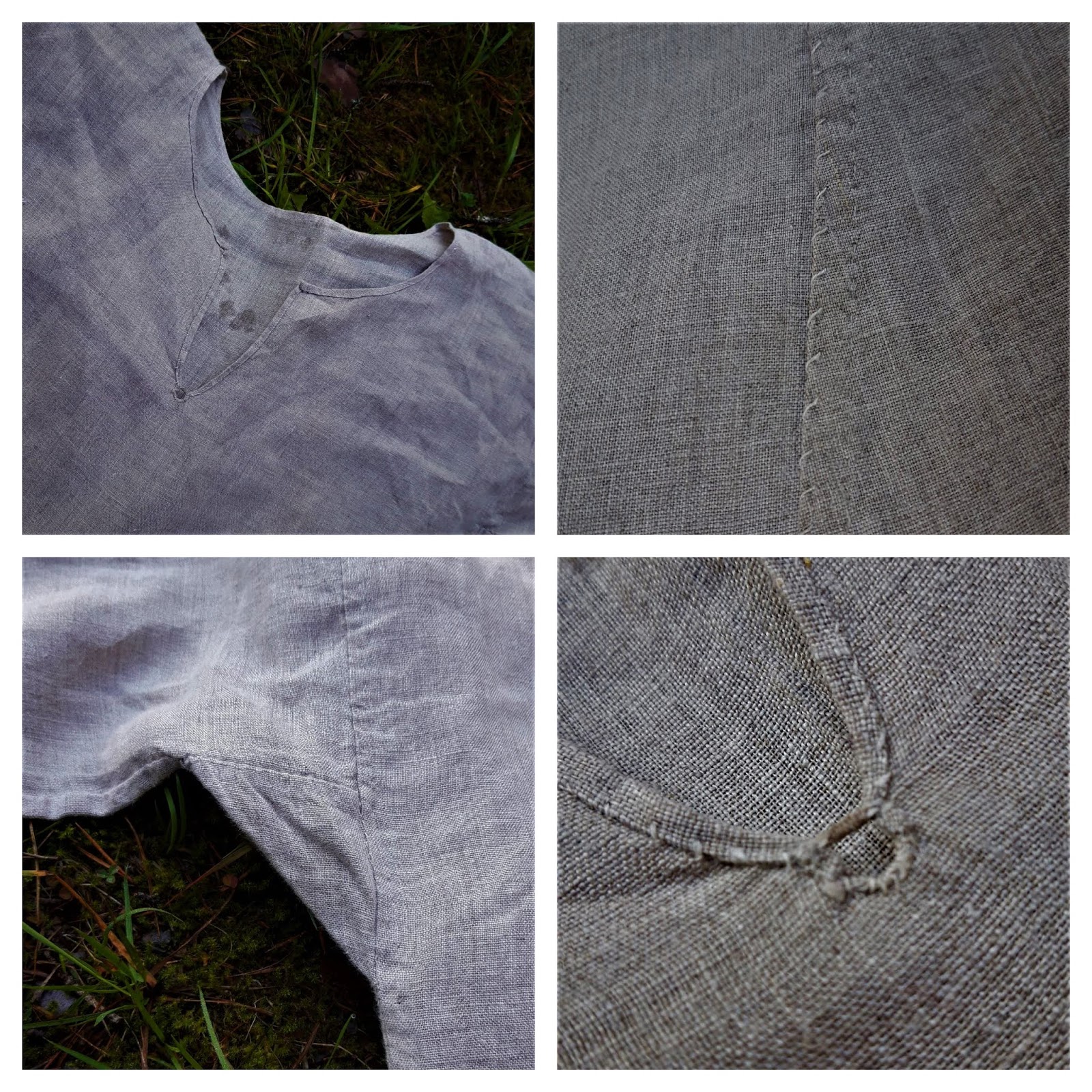
Villamekon alla minulla on samalla kaavalla leikattu pellavainen aluspaita, serk, jotka voidaan pitää myös sellaisenaan olkainmekon alla. Ohut ja tiheä valkaisematon pellava on Finkoniasta. Se on ommeltu pellavalangalla. / Underneath I'm wearing a linen smock, serk, that can also be used alone with the aprondress. The thin but dense unbleached linen is from a Finnish shop called Finkonia. It's sewn with linen thread.
Photo: neulansilmanlapi.blogspot.com/


Smokkr


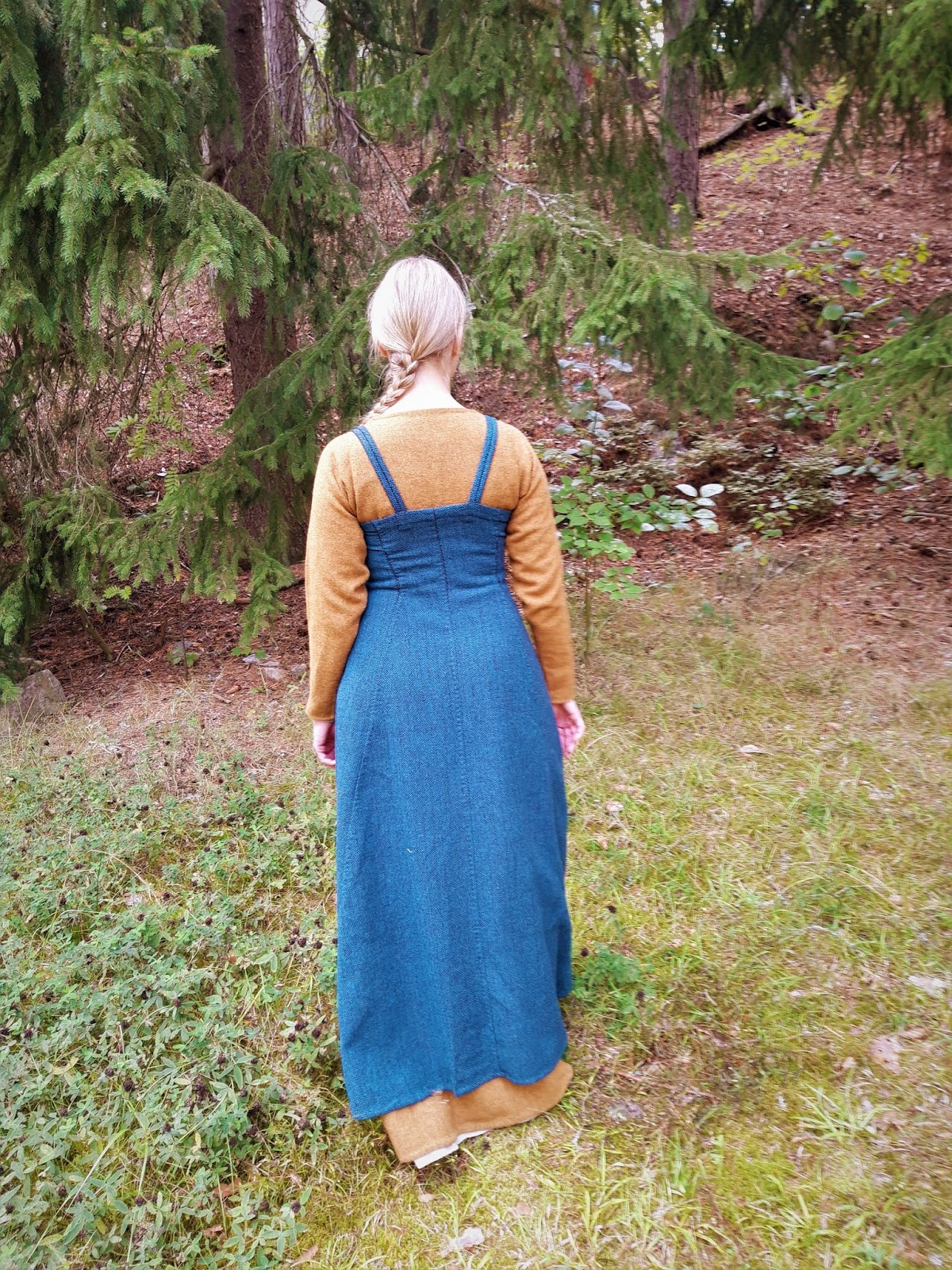
Keltaisen mekon päälle puetaan sinisestä timanttikuvioisesta villasta valmistettu olkainmekko, smokkr. Mekko on ommeltu käsin villalangalla. / On top I'm wearing a blue diamond patterned wool aprondress, smokkr. The dress is handsewn with wool thread. Photo: neulansilmanlapi.blogspot.com/


Yhtään kokonaista olkainmekkoa ei ole säilynyt. Tutkijoiden teoriat mekkojen mallista ja leikkauksesta vaihtelevat. Ne perustuvat tekstiilifragmentteihin, koruihin ja niiden sijaintiin rautakautisen haudan vainajan jäännösten päällä, sekä joihinkin aikalaiskuviin. / No complete surviving aprondress exists. There are different theories as to how they were constructed that are based on textile fragments, brooches, and their positioning on the body in the excavated graves, plus some pictorial evidence. Photo: neulansilmanlapi.blogspot.com/


Olkainmekkoni oli ollut enemmän tai vähemmän käyttövalmiina jo useamman vuoden. Se oli alunperin leikattu kolmesta palasta Nille Glaeselin kirjan kaavan mukaan. En kuitenkaan ollut tyytyväinen mekon istuvuuteen, joten laitoin sen palasiksi, lisäsin sivukappaleet etu ja takakappaleiden väliin ja istutin sen uudelleen. Siksi takakappaleet ovat tavallista kapeammat, mutta nyt mekko ainakin myötäilee notkoselkääni! / My aprondress had been in more or less usable condition for years. It was originally cut after the three pieced pattern in Nille Glaesel's book. Since I'd never been happy with the fit and the general shape, I decided to take it apart, add side pieces between the front and the back pieces, and refit it. This is why the two back pieces are a bit too narrow, but at least now the dress follows the line of my swayback!
Photo: neulansilmanlapi.blogspot.com/


Photo: neulansilmanlapi.blogspot.com/


Avokaulainen takki

Coat with a deep neckline 


On epäselvää käyttivätkö viikinkinaiset lainkaan kaftaanityyppisiä takkeja, kuten Birkan löytöjä tutkinut Inga Hägg on esittänyt. Jotkin tutkijat, kuten esimerkiksi Thor Ewing pitävät tätä epätodennäköisenä ja ovat ennemminkin sitä mieltä, että naiset käyttivät kaftaanin sijaan suorakaiteen muotoista vaippaa, kuten muinaissuomalaiset naiset. Tulkinnan varaa siis löytyy!

It's not clear wether Viking women wore a caftan type garment at all, as Inga Hägg who studied the finds from Birka has suggested. For example, Thor Ewing  finds this proposition unlikely. He thinks that women wore a rectangular cloak instead, like Iron Age Finnish women. That been said, there is clearly room  for interpretation!


Takissa on kaksi etukappaletta, kaksi sivukiila molemmilla puolilla, yksi takakappale ja yksi takakiila, sekä hihat. / The coat consists of two front pieces, two side gores on both sides, one back piece, one back gore, and the sleeves.
Photo: neulansilmanlapi.blogspot.com/


Tämän takin kaavan lähtökohtana oli Nille Glaeselin kirjan kaava -  tosin ilman hassuja lisäkiiloja. Täytyy sanoa, että jouduin muokkaamaan kaavaa aikalailla saadakseni sen toimimaan. / The starting point for the pattern came from Nille Glaesel's book - although I skipped the funny extra gores. I must say I had to make heavy changes to the pattern in order to make it work for me. Photo: neulansilmanlapi.blogspot.com/


Uusi takki ja olkainmekon uudistus tehtiin vain neljässä ja puolessa päivässä. Siitä syystä takin saumat on ommeltu koneella (koska joskus vaatteen valmistuminen on tärkeämpää kuin 100% autenttisuus), lukuun ottamatta hihojen kiinnitystä. Kaikki huolittelut on tehty käsin. / The new coat and the revamp of the aprondress were done in just four and a half days. That's why the coat is partially machine sewn (beacause there are times when it's more important to have a finished garment on time, even if you have to compromise on it's authentisity), save for the sleeves and the finishing touches.
Photo: neulansilmanlapi.blogspot.com/


Photo: neulansilmanlapi.blogspot.com/
neulansilmanlapi.blogspot.com/


Korut ja asusteet

The jewellery and accessories

Metallikorut ovat merkittävä osa viikinkinaisen asua: ne eivät ole pelkästään koristeita, sillä niillä oli käytännöllinen funktio vaatteiden kiinnittiminä. Kuvissa näkyvät pronssikorut on hankittu Historiska Fyndistä. Tämä ruotsalainen yritys on erikoistunut arkeologisten löytöjen pohjalta valmistettujen viikinkiaikaisten ja keskiaikaisten metallikorujen valmistukseen ja myyntiin. Suosittelen! 

Lasihelmien käyttötarkoitus sen sijaan vaikuttaa rajoittuneen koristautumiseen. Alimman lasihelminauhan olen saanut lahjaksi mieheltäni ja se helmet perustuvat ilmeisesti suomalaiseen hautalöytöön. Ylempään helminauhaan olen pujotellut aikojen saatossa keräilemiäni rautakauden tyyliin valmistettuja lasihelmiä.

Metal jewellery is an integral part of Viking womens clothing: they are not mere decorations, since they're used to fasten the garments. My bronze jewellery is  from Historiska Fynd, a Swedish company specializing in Viking and medieval jewellery that's based on archeological findings. I highly recommend them! 

The glass beads on the other hand, seem to be used for decorative purposes. The beads on the bottom string are a gift from my spouse, and they were made after a Finnish iron age burial find. The upper string consists of random iron age style glass beads I've collected over the years.


Photo: neulansilmanlapi.blogspot.com/


Puusankainen laukku on saanut inspiraationsa mm. Haithabusta ja Skandinaviasta löytyneistä puujäänteistä. Puuosat ovat Mikken käsialaa. / The bag with two wooden laths is inspired by the wooden fragments from Haithabu and other parts or Scandinavia. The wooden parts are made by Mikke. Photo: neulansilmanlapi.blogspot.com/


Huput

Hoods

Skjoldehamnin löytöä mukailevat huput täydentävät asua. Niitä siunaantui kolme - kolmessa päivässä. En rekonstruoinut hupun "muotolaskoksia" enkä korvien korkuudella olevia naruja. Ehkäpä lisään ne myöhemmin oranssiin huppuun... Eri väriset huput ovat myös siitä käteviä, että niitä voi yhdistellä monin tavoin asun osien kanssa.

The hoods are inspired by the Skjoldehamn find and they complete the outfit. I somehow managed to make three of them - in three days. I did not reconstruct the running stitches on the top part of the hood that are not exactley darts, but make the hood sit better on the wearer. I also skipped the braided strings that should be attached at  ear level. Perhaps I'll add them later to the orange hood... All in all, different colour hoods are handy when you want to  combine them with different parts of the outfit. 


Oranssi huppu muistuttaa eniten Skjoldehamnin huppua, sillä sen pääntiessä ei ole muotoilua. Se on myös ommeltu esikuvansa tavoin yliluottelemalla. Sininen ja keltainen huppu ovat identtiset: voin tarvittaessa yhdistää ne käännettäväksi hupuksi. (Sininen huppu kuvattu nurjalta puolelta.) / The orange hood is most alike to the Skjoldehamn find: the opening is straight and it's assembled with a whip stitch, unlike the other two. The blue and the yellow hood are identical, and I can combine them if I ever feel the need for a reversable warm winter hood. (The blue hood is photographed inside out.)
Photo: neulansilmanlapi.blogspot.com/


Pääntie on huoliteltu täytelangoilla samaan tapaan kuin Skjoldehamnin löytö. / I neatened the head opening in a similar way as the Skjoldehamn hood: by couching filler threads next to folded raw edges.
Photo: neulansilmanlapi.blogspot.com/


Photos: neulansilmanlapi.blogspot.com/


Photo: neulansilmanlapi.blogspot.com/


Tuesday, 14 March 2017

1780-luku: Uusi projekti, osa 1 - 1780's: A new project, part 1

Mitä 1780-luvun suomalaisella palvelustytöllä oli yllään? 

1. osa: alusvaatteet

What did a 1780's Finnish maid wear?

Part 1: undergarments


 1700-luvulla aluspaidan alaosa ommeltiin joskus säästäväisyyssyistä karkeampilaatuisesta pellavakankaasta kuin sen yläosa. During the 18th century, the lower part of the chemise or smock was sometimes made of a coarser fabric for economical reasons.

Inspiraatio

The inspiration 

Viime syksystä asti olen pyöritellyt toden teolla päässäni uutta 1700-luvun lopulle sijoittuvaa ompeluprojektia. Projekti perustuu vuonna 1995 julkaistuun paperinukkeen, jonka sisältämät puvut pohjautuvat pääosin Turun museokeskuksen (julkaisuaikana Turun maakuntamuseo) kokoelmiin. Paketissa on kaksi hahmoa: kustavilaisen ajan säätyläisrouva ja palvelustyttö. Ensin mainitulla on useampikin asukokonaisuus - kuten arvata saattaa. Palvelustytöllä vain yksi. Jos onni suo, niin ehkäpä pystyn tulevaisuudessa esittelemään kyseistä paperinukkea hieman tarkemmin.

Ever since last fall I've been planning a new late 18th century  sewing project. This  project is inspired by a set of paperdolls published in 1995. What is great about this is, that most of the dresses in this thing are based on actual garments that are kept in the collections of Turku Museum Centre. The set has two charachters: a late 18th century gentlewoman and her maid. The first mentioned has several outfits to choose from - as one might imagine. The servant gril has only one set of clothing. I hope I can show you some details of this lovely paperdoll set in the future.


1700-luvun aluspaita ulottui usein vain puolisääreen. An 18th century chemice usually reached around the mid shin.


1700-luvun lopun aluspaita

Late 18th century smock or chemise

1700-luvun aluspaidat valmistettiin aiempien vuosisatojen tapaa usein pellavasta. Puuvillasta valmistettuja aluspaitoja alkoi ilmaantua vasta vuosisadan lopulla. Paidat leikattiin yhä keskiajalta tuttuun tapaan suorakaiteita, nelikulmioita ja kolmiokiiloja yhdistelemällä. Joitakin vivahde-eroja kuitenkin oli: esimerkiksi hihat lyhenivät ensin 1600-luvulla ranteesta kyynärpäähän. 1700-luvun lopulla hihat kapenivat ja lyhenivät vielä entisestään.

Paidan omistajan sosioekonominen asema vaikutti käytettävissä olevan kankaan laatuun: vaikka säätyläisrouvillakin oli varaa teettää paitoja arvokkaasta hollanninpalttinasta, saattoivat hekin käyttää kotikutoisesta kankaasta valmistettuja paitoja arkipukiminaan. 


Räätälimestari Sieur Garsaltin kirjasta L'Art de la lingère, vuodelta 1771. Teos esittelee ranskalaisen (B) ja kaksi englantilaista leikkaustapaa (A ja C). Master tailor Sieur Garsalts book L'Art de la lingère from 1771. The books shows a French (B) and two English (A and C) ways to cut the smock. http://gallica.bnf.fr/ark:/12148/btv1b7200315v/f72.item.zoom


Linen was probably the most common material for 18th century smocks as it had been in the previous centuries. Cotton smocks appear first during the end of the century. The smocks were cut and pieced from squares and triangular gores, as they had been ever since the middle ages. The changes were quite small: for example, during the 17th century the sleeves became shorter, rising from the wrists to the elbows. During the end of the 18th century the sleeves became narrower and even shorter.

The socioeconomical status of the wearer could be seen on the quality of the fabrics: although a gentile lady could afford to have her smocks made out of the costly imported Dutch linens, even their everyday smock might have been made out of home spun and woven linens.  


Palvelustytön arkinen aluspaita

Serving girls everyday smock

Palvelijattaren aluspaita on leikattu englantilaiseen tapaan, joka vaikuttaa suositulta vuosisadan lopun Suomessa. Sen yläosa on keskipaksua valkoista pellavapalttinaa ja alaosa karkeampaa valkaisematonta pellavaa. Kaikki on ommeltu käsin pellavalangalla.

The maid's smock is cut in the English way, which appears to be the preferred way in late 18th century Finland. The top is made of mid weight white plainwoven linen and the lower part is made of a coarser unbleached linen. Everything is hand-sewn with linen thread.

Aluspaidan englantilainen leikkaus. The English cut of the smock.


Helman oikea puoli on leikattu viistoon... The right side of the hem is cut on bias...


... ja vasenta puolta täydentää kolmion muotoinen kiila - aivan kuten Garsaultin kirjassa! ... and the left side is completed with a triangular gore - just like in Garsault's book!


Kainalokiila ja ei niin siistit katesaumat. Ensi kerralla siistimmin.... The armpit gore and the not so neat felled seams. I'll try to do better next time...


Pellava-alushame

The linen Petticoat 


Alushameen kangas jäljittelee pehmeäksi käytössä kulunutta valkaisematonta rohdinpellavaa.

The linen fabric of the petticoat imitates the linens woven from flax tow and softened by regular use and washing.


1700-luvun palvelustytön alushame. 18th century servan girls petticoat.


Hame rakentuu yhdesta etu- ja takakappaleesta. Kapeammilla aikalaiskankailla eteen ja taakse olisi tullut sauma. The petticoat is made on a front and a back piece. With the narrower contemorary fabrics there would have been two additional seams on the centre front and back.


Alushame puetaan seuraavasti: ensin takaosan vyötärönauha sidotaan eteen... The petticoat is dressed like this: first the ribbons of the back piece are tied at the waist...


... lopuksi etuosa kiinnitetään samaan tapaan nauhoilla solmimalla. ...lastly, the front side is attached with the ribbon in a similar fashion.


Ja voilà: aluskerrokset on puettu! And voilà: the undergarments are on!


 PS. Pääasiat ansaitsevat aivan oman juttunsa. Lisää on tulossa!

 PS. The headwear deserves a posting of it's own. Stay tuned for more!


Sunday, 12 February 2017


Turun linnan rakastavaiset - Kuvasta todeksi

The Lover's of Turku Castle - From Image to Reality 


Photo: Karo Suominen


Turun linnan Portinvartijan kamarin läntiseltä seinältä löytyy kuva saksalaiseen tapaan pukeutuneesta parista. Maalaus on askarruttanut mieltäni aina siitä asti, kun aloitin työni linnan museo-oppaana vuonna 2010. Kyseinen maalaus tunnetaan varsin yleisesti nimellä "rakastavaiset". Se on yksi kolmesta huoneesta löytyvästä ihmishahmoja esittävistä kuva-aiheista. Neljäs maalausryhmä löytyy huoneen itäiseltä puolelta, jossa on samankaltaisia köynnöskuvioita kuin rakastavaisten ja pohjoiselta seinältä löytyvän hahmon ympäriltä.  Maalaukset on ajoitettu 1530-luvun taitteeseen.

There is an image of a couple dressed in the German style on the western wall in the room known as The Porter's Lodge in Turku Castle. The painting has intrigued my imagination ever since I began my work there as a museum guide back in 2010. They are known as "The Lovers". They're one of three images remaining in the room depicting people. The fourth image group depicts similar vegetation that can be seen surrounding The Lovers and another figure on the norther wall. The paintings are dated to c. 1530.


Kuva: Museovirasto


Olin jo pitkään haaveillut maalauksessa esiintyvien pukujen valmistamisesta. Vuoden 2016 taitteessa päätin vihdoinkin ryhtyä tuumasta toimeen. Tämän projektin johdosta muut ompelukset saivat luvan odottaa. Puvut on kuvattu tammikuussa Turun linnan renessanssikerroksessa.  Entä missä ne voi nähdä livenä? No 17.2.2017 aukeavassa näyttelyssä Valtapeliä - Reformaatio Suomessa Turun linnassa tietenkin!

For a long time, I had dreamed about making the garments depicted on the image. At last, in the beginning of the year 2016 I finally decided to start the project. This was indeed the project of the 2016, so other sewing projects were put aside. The photo shoot took place in January on the renaissance floor of Turku Castle. And where can you see these garments? In the exhibition Game of Power - Reformation in Finland which open in Turku Caslte on the 17th of February 2017!
 

Photo: Karo Suominen


Naisen puvussa on neljä kerrosta: alimpana ohuesta valkeasta pellavasta valmistettu aluspaita, jonka päälle on puettu ruskeasta villasekoitteesta valmistettu hihaton liivihame. Koska maalauksessa naisen rintamuksen avonaisen kauluksen alta ei näy aikakaudelle muutoin tyypillistä korkeakauluksista aluspaitaa, päädyin matalampaan pääntiehen. Esikuva löytyy täältä.

The woman's attire has four layers: a fine white linen smock and a brown wool-blend kirtle/petticoat without sleeves. Since the open partlet on the open collar of the partler in the painting does not reveal a typical high necked smock, I decided to make one with a lower neckline. The inspiration for this neckline can be found here.


Photo: Karo Suominen


Päällyshameena on samankaltainen hihallinen liivihame, jonka pääntie, miehusta ja kalvosimet on koristeltu vihreällä damastilla. Hameen helmaa koristaa harmaasta villasta tehtyy päärme. Päällyshame on leikattu n. 5 cm lyhyemmäksi kuin alushame. Jälkeenpäin ajatellen päällyspuku olisi saanut olla vieläkin lyhyempi, jotta aluspuvun helma tulisi paremmin esiin.

The overdress or gown is similarly cut sleeved kirtle, with green damask decorations on the neckline, bodice front and the cuffs. The red dress has a wide guard of grey wool at the bottom of the hem.  On hindsight, the overgown could have been even shorter.


 Photo: Karo Suominen

Maalauksessa naisen asun kuviokangas on maalattu vihreällä ja punaruskealla. En kuitenkaan onnistunut löytämään hinta-laatusuhteeltaan sopivaa kaksiväristä damastia tai leikattua samettia, joten päädyin yksiväriseen vaihtoehtoon. Damasti on ostettu täältä. Se muistuttaa hieman silkkiä, joka löytyy Metin kokoelmista ja eräästä Hans Holbein vanhemman maalamasta muotokuvasta. 

The patterned fabric on the painting was done with green and reddish-browns colours. I was not able to find a suitable and affordable two-toned fabric, so I settled for a monochrome alternative. I got the damast from here. It's similar to a silk in the Met collections and the one depicted in a portrait by Hans Holbein the elder.

Photo: Karo Suominen


Alkuperäisessä maalauksessa vyön ja esiliinan yksityiskohdat ovat epäselvät. Päädyin lopulta nk. hunajakenno-smokattuun esiliinan, sillä tällä tavoin rypytetty esiliina korostaa muodikasta vatsan pyöreyttä entisestään.

The details of the belt and the apron are not very clear on the painting. In the end I decided upon the well documented honeycomb smocking on the apron, because it accentuates the fashionable curve of the belly.


Photo: Karo Suominen


Asun viimeistelee pääntien peittävä rintamus/kaulus, (saks. goller, ruots. krage, engl. partlet). Damastista valmistetussa kauluksessa on villavuori ja se on reunustettu samalla keltaisella villalla. Valinta on kompromissi, jonka kautta olen tavoitellut lähinna visuaalista harmoniaa pukujen esikuvan kanssa. Villainen reunus on ehkä historiallisessa mielessä outo valinta, sillä tällaisten vaatekappaleiden koristeluun käytettiin useimmiten arvokkaampia kankaita, kuten silkkiä ja samettia. Alkuperäisenä ajatuksenani olikin käyttää keltaista samettia, mutta en onnistunut löytämään miehen asussa käytetyn villan kanssa yhteen sopivaa sävyä. 

The outfit is finnished with a partlet (goller in german and krage in swedish). It's made of the green damast and has a white woollen lining for warmth. The edges are decorated with fine yellow wool. The choice was a compromise, through which I was aiming to harmonize the visual effect with the original image. Historically speaking, a woollen decoration on a damask partlet is odd, since different silks and velvets would have been the prefferred choice of the day. My original idea was to use some sort of silk or velvet for this job, but I was unable to locate either in a colour that would match the yellow wool  nicely.


Photo: Karo Suominen


Pussukka on valmistettu säämiskästä. Sen esikuvana toimi pussukkatyyppi, joka löytyy esim. Germanisches Nationalmuseumista

The purse is made of shammy leather by Mikke. It's modelled after the type found for example in Germanisches Nationalmuseum.


Photo: Karo Suominen


Naisen hattu on valmistettu huovutetusta villapalttinasta. Hatun tukirunkona on olkihatun lieri. Sen reuna on lävistetty taltalla. Koristenauha on pujoteltu reikien läpi. Miehen hattu on tehty samalla periaatteella, mutta päällystin sen villan sijaan sametilla ja koristenauha on vihreää taftia.

The hat is made of heavily felted wool tabby. It's supported with the brim of a strawhat. The edge of the fabric is pierced with a chisel and the decorative ribbon is pulled through the openings. The construction of the man's hat is basically the same, but I used velvet to cover it and green taffeta for the brim decoration.


Photo: Karo Suominen


Itselleen on toki aina mukavaa tehdä uusia vaatteita, mutta tässä projektissa ehdoton suosikkini on kuitenkin miehen asu. Se on hävyttömän ihana. Ennen kaikkea, se vaatii aika paljon käyttäjältään. Kaikeksi onneksi minulla olikin sopiva malli mielessä. Ja ei: en kysynyt haluaako Mikke ylipäätään tällaiset vermeet... 

Although it's always nice to make new things that you can wear yourself, my all time favourite is the man's outfit. It's outrageously faboulous. It definately requires quite a lot from the wearer. And no: I did not ask how Mikke felt about wearing such an outfit...


Photo: Karo Suominen


Photo: Karo Suominen


Miehen röijy ja hoset ovat valkoista villaa. Nyörit ovat nahkaa, pointit messinkiä ja sukkanauhat vihreää silkkitaftia. Hattu on punaista samettia. Aluspaidaksi päätyi lopulta korkeakauluksinen "harjoituspaita". Se onkin ainoa osa koko puvustosta, joka on koottu koneella, mutta huoliteltu ja kirottu käsin. Tarkoitukseni oli tehdä toinen paita täysin käsin, mutta joskus elämä tulee väliin ja sotkee alkuperäiset suunnitelmat...

The doublet, or wams, and the hose are made of the same white wool. The  laces are leather, the aiglet are made of brass and the garters are a rectangular piece of silk taffeta.  The hat is made of velvet. The smock is the only garment that was assmbled by machine, but finished and embroidered by hand. Other pieces are entirely hand-sewn. Originally this smock was supposed to be a practice piece and I was supposed to do another one entirely by hand, but alas, life got in the way...


Photo: Karo Suominen

Photo: Karo Suominen


Photo: Karo Suominen


Miehen takkimaisen lievejakun, waffenrockin helma on täyskello ja leikattu neljästä osasta. Jokainen raita on leikattu muotoon ja ommeltu kiinni hamekankaaseen. Kyllä, siihen meni ikuisuudelta tuntuva aika... Hihat on vuorattu vihreällä pellavalla.

The skirt of the coat like arms jacket, waffenrock, is a full circle. It's cut from four 1/4 piece. Each stripe is cut to form and sewn to the skirt fabric. Yes, it felt like it took forever to sew those in place... The sleeves are lined with green linen.


Kengät: Elina Laitinen. Shoes by Elina Laitinen. Photo: Karo Suominen


Jalassa on tietysti aivan mahtavan hienot maalauksen innoittamat kengät. Niiden tekijä on taitava ja lahjakas muinaistekniikan artesaani Elina Laitinen, joka myös kävi sivukaupalla läpi kenkiin liittyviä arkeologisia lähdeteoksia.  

The outfit could not be completed without shoes. These are handmade by the talented artesan of ancient techniques Elina Laitinen. They are inspired by the painting and I know she poured ower archeological source material over these.


Photo: Karo Suominen


Kuvauksissa oli mukana tietysti myös Jani, jonka asun inspiraationa on toiminut portinvartijan kamarin pohjoiselta seinältä löytyvä maalaus. Hän myös yllätti meidät iloisesti pukemalla ja aseistamalla Mikken asiaan kuuluvin varustein.

Jani was of course part of the photo shoot, wearing a landsknecht outfit inspired by the painting on the northern wall of the Porter's Lodge. He had a surprise for us and he equipped Mikke with the appropriate armoury.


Photo: Karo Suominen


Photo: Karo Suominen


Photo: Karo Suominen


Landsknecht romantiikkaa....?

Landsknecht romance....? 
 

 Photo: Karo Suominen